Gnu icecat
Содержание:
AppKey 對應表
AppCommand values from
| 1 | APPCOMMAND_BROWSER_BACKWARD |
| 2 | APPCOMMAND_BROWSER_FORWARD |
| 3 | APPCOMMAND_BROWSER_REFRESH |
| 4 | APPCOMMAND_BROWSER_STOP |
| 5 | APPCOMMAND_BROWSER_SEARCH |
| 6 | APPCOMMAND_BROWSER_FAVORITES |
| 7 | APPCOMMAND_BROWSER_HOME |
| 8 | APPCOMMAND_VOLUME_MUTE |
| 9 | APPCOMMAND_VOLUME_DOWN |
| 10 | APPCOMMAND_VOLUME_UP |
| 11 | APPCOMMAND_MEDIA_NEXTTRACK |
| 12 | APPCOMMAND_MEDIA_PREVIOUSTRACK |
| 13 | APPCOMMAND_MEDIA_STOP |
| 14 | APPCOMMAND_MEDIA_PLAY_PAUSE |
| 15 | APPCOMMAND_LAUNCH_MAIL |
| 16 | APPCOMMAND_LAUNCH_MEDIA_SELECT |
| 17 | APPCOMMAND_LAUNCH_APP1 |
| 18 | APPCOMMAND_LAUNCH_APP2 |
| 19 | APPCOMMAND_BASS_DOWN |
| 20 | APPCOMMAND_BASS_BOOST |
| 21 | APPCOMMAND_BASS_UP |
| 22 | APPCOMMAND_TREBLE_DOWN |
| 23 | APPCOMMAND_TREBLE_UP |
| 24 | APPCOMMAND_MICROPHONE_VOLUME_MUTE |
| 25 | APPCOMMAND_MICROPHONE_VOLUME_DOWN |
| 26 | APPCOMMAND_MICROPHONE_VOLUME_UP |
| 27 | APPCOMMAND_HELP |
| 28 | APPCOMMAND_FIND |
| 29 | APPCOMMAND_NEW |
| 30 | APPCOMMAND_OPEN |
| 31 | APPCOMMAND_CLOSE |
| 32 | APPCOMMAND_SAVE |
| 33 | APPCOMMAND_PRINT |
| 34 | APPCOMMAND_UNDO |
| 35 | APPCOMMAND_REDO |
| 36 | APPCOMMAND_COPY |
| 37 | APPCOMMAND_CUT |
| 38 | APPCOMMAND_PASTE |
| 39 | APPCOMMAND_REPLY_TO_MAIL |
| 40 | APPCOMMAND_FORWARD_MAIL |
| 41 | APPCOMMAND_SEND_MAIL |
| 42 | APPCOMMAND_SPELL_CHECK |
| 43 | APPCOMMAND_DICTATE_OR_COMMAND_CONTROL_TOGGLE |
| 44 | APPCOMMAND_MIC_ON_OFF_TOGGLE |
| 45 | APPCOMMAND_CORRECTION_LIST |
| 46 | APPCOMMAND_MEDIA_PLAY |
| 47 | APPCOMMAND_MEDIA_PAUSE |
| 48 | APPCOMMAND_MEDIA_RECORD |
| 49 | APPCOMMAND_MEDIA_FAST_FORWARD |
| 50 | APPCOMMAND_MEDIA_REWIND |
| 51 | APPCOMMAND_MEDIA_CHANNEL_UP |
| 52 | APPCOMMAND_MEDIA_CHANNEL_DOWN |
| 53 | APPCOMMAND_DELETE |
| 54 | APPCOMMAND_DWM_FLIP3D |
productObject
getReturnCode
- returnCode.FAIL (-1)
- returnCode.SUCCESS (1)
getErrorMessage
returns ErrorMessage {string}
Example: The requested XML data-sheet is not present in the Icecat database.
getName
returns Product Name {string}
Example: X4071UHSU-B1
getTitle
returns Product Title {string}
Example: iiyama X4071UHSU-B1 39.5″ LED 4K Ultra HD Black public display
getReleaseDate
returns Product Release Date YYYY-MM-DD {string}
Example: 2015-10-04
getLongDescription
returns {string}
getShortDescription
returns {string}
getProductManualPDFurl
returns {string}
getProductUrl
returns {string}
getSupplier
returns {string}
Example: iiyama
getCategory
returns {string}
Example: public displays
getFamily
returns {object}
Example: {«id»:»30340″,»name»:»ProLite»}
getId
Get the Icecat product ID
returns {string}
Example: 29900045
getEan
Get the first EAN from the productXML
returns {string}
Example: 4948570114344
getImages
returns {array}
Example:
  {
    IsMain: 'Y',
    HighImg: 'http://images.icecat.biz/img/gallery/29900045_1198.jpg',
    LowImg: 'http://images.icecat.biz/img/gallery_lows/29900045_1198.jpg',
    ThumbImg: 'http://images.icecat.biz/img/gallery_thumbs/29900045_1198.jpg'
  },
  {
    IsMain: undefined,
    HighImg: 'http://images.icecat.biz/img/gallery/29900045_3889.jpg',
    LowImg: 'http://images.icecat.biz/img/gallery_lows/29900045_3889.jpg',
    ThumbImg: 'http://images.icecat.biz/img/gallery_thumbs/29900045_3889.jpg'
  },
  {
    IsMain: undefined,
    HighImg: 'http://images.icecat.biz/img/gallery/29900045_6765.jpg',
    LowImg: 'http://images.icecat.biz/img/gallery_lows/29900045_6765.jpg',
    ThumbImg: 'http://images.icecat.biz/img/gallery_thumbs/29900045_6765.jpg'
  }
;
getSpecifications
returns {array}
getMultimediaObjects
returns {Array}
getCategoryFeatureGroups
returns {Array}
Example:
  { id: '10074', name: 'Display' },
  { id: '10080', name: 'Audio' },
  { id: '10083', name: 'Ports & interfaces' },
  { id: '10073', name: 'Weight & dimensions' },
  { id: '10081', name: 'Power' },
  { id: '10084', name: 'Operational conditions' },
  { id: '10871', name: 'Technical details' },
  { id: '10078', name: 'Packaging data' },
  { id: '10101', name: 'Other features' },
  { id: '10869', name: 'Design' },
  { id: '10870', name: 'Performance' },
  { id: '16263', name: 'Computer system' }
;
Tor browser

Next up we have the Tor browser. The Tor browser is a hardened version of Firefox that is configured to run on the Tor network. By default, the Tor Browser is a secure browser that protects you against browser fingerprinting, but it also has some disadvantages.
Because it uses the Tor network, which routes traffic over three different hops, download speeds with the Tor browser can be quite slow. The default version may also break some sites due to script blocking. Finally, there are also drawbacks with the Tor network itself, including malicious exit nodes, high latency, dependence on US government financing, and some consider it to be fundamentally compromised. (See the pros and cons of Tor here.)
Another option is to use the Tor browser with the Tor network disabled. In this sense, the Tor browser will work like the other browsers we’ve covered above. Additionally, you can simply run a VPN in the background. Like the Tor network, a VPN will also encrypt your traffic and hide your IP, but it will be much faster.
The instructions for using the Tor browser without the Tor network are in my browser fingerprinting guide. Be careful when adjusting the settings for the Tor browser, however, as this may compromise the browser’s built-in privacy and security features.
Distribution[edit]
GNU IceCat is available as a free download for the IA-32, x86_64, and PowerPC architectures. Both binaries and source are available, though the current build is available only for GNU/Linux. Some distributions offer binary and source packages through their repositories, such as Trisquel,Parabola GNU/Linux-libre and Fedora.
IceCat is also available for macOS 10.4 and higher. Any Mac user with these versions of macOS can install IceCat through Fink. For the Mac, it is available for both IA-32 & PowerPC architectures.
Unofficial builds are available for Windows (Vista or newer) and Android (2.3 or newer).
History[edit]
Origins of the nameedit
The Mozilla Corporation owns the trademark to the Firefox name and denies the use of the name «Firefox» to unofficial builds that fall outside certain guidelines. Unless distributions use the binary files supplied by Mozilla, fall within the stated guidelines, or else have special permission, they must compile the Firefox source with a compile-time option enabled that creates binaries without the official branding of Firefox and related artwork, using either the built-in free artwork, or artwork provided at compile time.
This policy led to a long debate within the Debian Project in 2004 and 2005. During this debate, the name «Iceweasel» was coined to refer to rebranded versions of Firefox. The first known use of the name in this context is by Nathanael Nerode, in reply to Eric Dorland’s suggestion of «Icerabbit». It was intended as a parody of «Firefox.» Iceweasel was subsequently used as the example name for a rebranded Firefox in the Mozilla Trademark Policy, and became the most commonly used name for a hypothetical rebranded version of Firefox. By January 1, 2005, rebranding was being referred to as the «Iceweasel route».
In August 2005, the Gnuzilla project adopted the GNU IceWeasel name for a rebranded distribution of Firefox that made no references to nonfree plugins.
The term «ice weasel» appeared earlier in a line which cartoonist Matt Groening fictionally attributed to Friedrich Nietzsche: «Love is a snowmobile racing across the tundra and then suddenly it flips over, pinning you underneath. At night, the ice weasels come.«
Debian was originally given permission to use the trademarks, and adopted the Firefox name. However, because the artwork in Firefox had a proprietary copyright license at the time, which was not compatible with the Debian Free Software Guidelines, the substituted logo had to remain. In 2006, Mozilla withdrew their permission for Debian to use the Firefox name due to significant changes to the browser that Mozilla deemed outside the boundaries of its policy, changes which Debian felt were important enough to keep, and Debian revived the Iceweasel name in its place.
Subsequently, on 23 September 2007, one of the developers of the GNU IceWeasel package announced that the name would be changed to GNU IceCat from IceWeasel in the next release, so as to avoid confusion with Debian’s separately maintained, unrelated rebranding of Firefox. The name change took place as planned and IceCat is the current name.
Version historyedit
| Version (non-patch only) | Version Firefox & Gecko | Release date | Major changes |
|---|---|---|---|
| 2.0.0.11-g1 | 2.0.0.11 | ||
| 2.0.0.12-g1 | 2.0.0.12 | ||
| 3-g1 | 3.0 | July 2008 | Differences from Firefox: to neutralize the functions of spyware sites, made into a separate extension. |
| 3.0.1-g1 | 3.0.1 | 27 July 2008 | Support function X-geometry |
| 3.5 | 3.5 | 12 July 2009 | |
| 3.6.16 | 3.6.16 | 24 March 2011 | |
| 4.0 | 4.0 | 11 April 2011 | |
| 5.0 | 5.0 | 27 June 2011 | |
| 6.0 | 6.0 | 18 August 2011 | |
| 7.0 | 7.0 | 2 October 2011 | |
| 9.0.1 | 9.0.1 | 28 December 2011 | |
| 10.0 | 10.0 | 11 February 2012 | |
| 13.0.1 | 13.0.1 | 12 July 2012 | |
| 14.0 | 14.0 | 21 August 2012 | |
| 17.0.1 | 17.0.1 | 1 December 2012 | |
| 24.0 | 24.0 | 16 October 2013 | |
| 52.1.0 | 52.1.0 | 5 May 2017 | |
| 52.3.0 | 52.3.0 | 1 September 2017 | |
| 52.6.0 | 52.6.0 | 25 February 2018 | |
| 60.3.0 | 60.3.0 | 9 November 2018 | |
| 60.7.0 | 60.7.0 | 2 June 2019 |
Mejoras de seguridad
IceCat incluye mejoras en la seguridad, como el bloqueo de imágenes no visualizables de terceros cookie, también conocidas como web bugs (Esta opción está disponible en Firefox 1.0, 1.5, y 3.0, pero la interfaz gráfica no está disponible en la 2.0). GNU IceCat también proporciona avisos para redirecciones de URL.
En la versión 3.0.2-g1, el certificado de CAcert.org, una Autoridad de certificación, es añadido a los certificados de confianza de la raíz. En una discusión de la lista de correo savannah-hackers-public, se ha mostrado una clara preocupación en torno a esta decisión.
La extensión GNU LibreJS detecta y bloquea software JavaScript no libre.
Hubo algunas sugerencias hechas por el Google Summer of Code en el año 2008 para mejorar IceCat. Estas incluyen:
- Portar IceCat al código de Mozilla Firefox 3.
- Más apoyo a los plugins libres como Gnash.
- Cambios en las características de privacidad.
La proposición de portar IceCat al código de Mozilla Firefox 3 fue aceptada y completada por Giuseppe Scrivano.
Pale Moon browser

Pale Moon is another open-source fork of Firefox, which aims for efficiency and customization. In testing out Pale Moon, it does indeed offer great customization options, as well as support for older Firefox add-ons and its own lineup of add-ons. The design feels a bit dated, but it’s also not overly-cluttered and is lightweight and fast.
Pale Moon is currently available on Windows and Linux, with other operating systems in development. Unlike other Firefox forks, Pale Moon runs on its own browser engine, Goanna, which is a fork of Gecko (used by Firefox).
Opinions on Pale Moon can be rather mixed. The Pale Moon website has some interesting information; here are a few useful links I found:
- Technical Details
- Release Notes
- Roadmap
- Rumor Control
productObject
getReturnCode
- returnCode.FAIL (-1)
- returnCode.SUCCESS (1)
getErrorMessage
returns ErrorMessage {string}
Example: The requested XML data-sheet is not present in the Icecat database.
getName
returns Product Name {string}
Example: X4071UHSU-B1
getTitle
returns Product Title {string}
Example: iiyama X4071UHSU-B1 39.5″ LED 4K Ultra HD Black public display
getReleaseDate
returns Product Release Date YYYY-MM-DD {string}
Example: 2015-10-04
getLongDescription
returns {string}
getShortDescription
returns {string}
getProductManualPDFurl
returns {string}
getProductUrl
returns {string}
getSupplier
returns {string}
Example: iiyama
getCategory
returns {string}
Example: public displays
getFamily
returns {object}
Example: {«id»:»30340″,»name»:»ProLite»}
getId
Get the Icecat product ID
returns {string}
Example: 29900045
getEan
Get the first EAN from the productXML
returns {string}
Example: 4948570114344
getImages
returns {array}
Example:
  {
    IsMain: 'Y',
    HighImg: 'http://images.icecat.biz/img/gallery/29900045_1198.jpg',
    LowImg: 'http://images.icecat.biz/img/gallery_lows/29900045_1198.jpg',
    ThumbImg: 'http://images.icecat.biz/img/gallery_thumbs/29900045_1198.jpg'
  },
  {
    IsMain: undefined,
    HighImg: 'http://images.icecat.biz/img/gallery/29900045_3889.jpg',
    LowImg: 'http://images.icecat.biz/img/gallery_lows/29900045_3889.jpg',
    ThumbImg: 'http://images.icecat.biz/img/gallery_thumbs/29900045_3889.jpg'
  },
  {
    IsMain: undefined,
    HighImg: 'http://images.icecat.biz/img/gallery/29900045_6765.jpg',
    LowImg: 'http://images.icecat.biz/img/gallery_lows/29900045_6765.jpg',
    ThumbImg: 'http://images.icecat.biz/img/gallery_thumbs/29900045_6765.jpg'
  }
;
getSpecifications
returns {array}
getMultimediaObjects
returns {Array}
getCategoryFeatureGroups
returns {Array}
Example:
  { id: '10074', name: 'Display' },
  { id: '10080', name: 'Audio' },
  { id: '10083', name: 'Ports & interfaces' },
  { id: '10073', name: 'Weight & dimensions' },
  { id: '10081', name: 'Power' },
  { id: '10084', name: 'Operational conditions' },
  { id: '10871', name: 'Technical details' },
  { id: '10078', name: 'Packaging data' },
  { id: '10101', name: 'Other features' },
  { id: '10869', name: 'Design' },
  { id: '10870', name: 'Performance' },
  { id: '16263', name: 'Computer system' }
;
Возможности
Браузер Brave обладает всеми необходимыми базовыми возможностями для выполнения веб-серфинга, доступными и в других браузерах.
Другие возможности Brave:
- Встроенная блокировка рекламы.
- Программа блокирует трекеры отслеживания на веб-сайтах и вредоносное программное обеспечение.
- Для каждого сайта можно задать собственные настройки блокировки.
- Отображается ежедневная статистика: количество заблокированных экземпляров рекламы, трекеров, скриптов, куки (cookie).
- Brave использует защищенный протокол HTTPS (когда это возможно) для сайтов, которые не поддерживают HTTPS.
- Приватные окна с автоматической поддержкой Tor.
- Плагины, доступные для Brave, используют корректные настройки конфиденциальности.
- Brace Sync — синхронизация настроек и закладок для различных. Синхронизированные данные хранятся в зашифрованном виде.
- Встроенный менеджер паролей.
 Вкладка браузера со статистикой заблокированных компонентов. Brave 0.59.35.
What is Free Software?
Free software means the users have the freedom to run,
copy, distribute, study, change and improve the software.
Free software is a matter of liberty, not price. To understand the
concept, you should think of “free” as in “free
speech”, not as in “free beer”.
More precisely, free software means users of a program have
the four essential
freedoms:
- The freedom to run the program as you wish,
for any purpose (freedom 0). - The freedom to study how the program works, and change it so it
does your computing as you wish (freedom 1). Access to the source
code is a precondition for this. - The freedom to redistribute copies so you can help others
(freedom 2). - The freedom to distribute copies of your modified versions
to others (freedom 3). By doing this you can give the whole
community a chance to benefit from your changes.
Access to the source code is a precondition for this.
Developments in technology and network use have made these freedoms
even more
important now than they were in 1983.
Nowadays the free software movement goes far beyond developing the
GNU system. See the Free Software
Foundation’s web site for more about what we do, and a list
of ways you can help.
Iridium browser

Iridium is a secure browser that is based on Chromium, configured for more privacy. This might be a good option for anyone wanting a browser that supports Chrome extensions, while also having much more privacy than you’d get from Chrome.
Note: While Iridium supports Windows, Mac OS, and Linux, there is no option for mobile users on iOS and Android.
The following excerpt from Iridium’s official site provides a good overview of this secure browser:
Iridium offers numerous security and privacy enhancements over Chrome, along with regular updates and releases. You can see how Iridium differs from Chromium here. All source code is available on GitHub.
Conclusion on secure browsers and privacy
A well-configured secure browser is crucial for protecting your data as you browse the web with privacy.
Finding the best secure browser all comes down to identifying the best fit for your unique needs. Since this is a personal decision with subjective criteria, I tend to avoid recommending only one option for all use cases.
In addition to using a secure browser that is configured to protect your privacy, you should also consider using a good ad blocker. Ads function as tracking to collect your browsing data and serve you targeted ads. If you aren’t blocking ads, your activities can be tracked by third-party advertising networks, with any site hosting ads.
In terms of privacy, you may also want to protect yourself against browser or device fingerprinting and WebRTC browser leaks, which can expose your identity even when using a good VPN service.
Other roundup guides on Restore Privacy:
- Secure Email Services
- Best VPN Services
- Private Search Engines
- Password Managers
- Ad Blockers
- Best Cloud Storage
- Best Secure Messaging Services
Browser add-ons for security and privacy
In addition to adjusting the settings within your browser, there are also a number of different add-ons or extensions you can install to improve your browser’s privacy and security.
Here are a few different options, but they may not all be supported by the browser you are using:
- uBlock Origin – This is one of the best browser-based ad blockers available that will also protect you against tracking.
- HTTPS Everywhere – An add-on from the folks at Electronic Frontier Foundation, this will force websites to use a secure HTTPS encrypted connection (when available).
- Privacy Badger – Privacy Badger is also from EFF that blocks spying ads and trackers.
- Cookie Autodelete – This will automatically delete cookies that are no longer needed from your browser.
- Decentraleyes – This protects you against tracking via content delivery networks.
- uMatrix – This gives you control over all the requests that may be tracking you as you visit different websites (extensive configuration necessary).
- NoScript – NoScript allows you to customize exactly which scripts run on the websites you visit. Like uMatrix, this is for advanced users and requires lots of customization.
Warning: Be cautious about using third-party add-ons and browser extensions. Do your research first, since add-ons could function as spyware and data collection tools for third parties. This is especially true with free VPN services or browser proxy add-ons, even if they are highly rated in the Google Play or Apple stores.
Additional security features[edit]
IceCat includes additional security features, such as the option to block third party zero-length image files resulting in third-party cookies, also known as web bugs (This feature is available in Firefox 1.0, 1.5, and 3.0, but the UI option was absent on 2.0). GNU IceCat also provides warnings for URL redirection.
In version 3.0.2-g1, the certificate of CAcert.org, a certificate authority, has been added to the list of trusted root certificates. Concern about that decision has been raised in a discussion on the savannah-hackers-public mailing list.
The GNU LibreJS extension detects and blocks non-free non-trivial JavaScript.
IceCat also has functionality to set a different each for different domains in . For example, setting a mobile user agent string for a desired DNS domain would make it possible to view the mobile version of a website on a desktop operating system.
Historia
Versiones de GNUzilla IceWeasel
En agosto de 2005, el equipo GNUzilla aprobó a IceWeasel como el nombre para la bifurcación de Firefox usando imágenes y demás gráficos completamente libres.
La primera liberación de GNUzilla IceWeasel se basaba en la 1.5.0.4 versión de Firefox. No hubo liberación alguna basada en Firefox 1.5.0.5 o 1.5.0.6. La versión siguiente fue la 2.0.0.13, publicado en abril de , y posteriormente la 3.0, que fue subida a la web de GNU, y que se anunció el mismo día a través de una lista de correo el martes 1 de julio de 2008.
Cambio de nombre
El 23 de septiembre de , uno de los desarrolladores anunció oficialmente sobre una lista de correo para GNUzilla que la próxima versión se llamaría GNU IceCat. La razón citada es que Debian ya utilizaba el nombre Iceweasel (con w minúscula) (utilizado por IceCat hasta ese momento) para su propio fork de Firefox (desde el 13 de noviembre de 2006), y para evitar confusiones, ya que estos dos bifurcaciones son independientes una de otra. El cambio de nombre se llevó a cabo como estaba previsto e IceCat es el nombre actual.
Versiones
- GNU IceCat 2 (Versión 2.0.0.11-g1, publicada el 12 de enero de 2008)
- GNU IceCat 3 (23 de julio de 2008)
- GNU IceCat 4 (10 de abril de 2011)
- GNU IceCat 5 (27 de junio de 2011)
- GNU IceCat 6
- GNU IceCat 7
- GNU IceCat 9
- GNU IceCat 10
- GNU IceCat 12
- GNU IceCat 13
- GNU IceCat 14
- GNU IceCat 17
- GNU IceCat 24
- GNU IceCat 31 (2014)
- GNU IceCat 38 (2015)
- GNU IceCat 45 (2016)
- GNU IceCat 60 (2018)
Las versiones se suelen actualizar con el código fuente de Mozilla Firefox.
Distribution
GNU IceCat is available as a free download for the IA-32, x86_64, and PowerPC architectures. Both binaries and source are available, though the current build is available only for GNU/Linux. Some distributions offer binary and source packages through their repositories, such as Trisquel,Parabola GNU/Linux-libre and Fedora.
IceCat is also available for macOS 10.4 and higher. Any Mac user with these versions of macOS can install IceCat through Fink.
For the Mac, it is available for both IA-32 & PowerPC architectures.
Unofficial builds are available for Windows (Vista or newer) and Android (2.3 or newer).
Firefox (modified and tweaked for privacy)
Firefox is a great all-around browser for privacy and security. It offers strong privacy protection features, many customization options, excellent security, and regular updates with an active development team. The newest version of Firefox is fast and light-weight with many privacy customization options.
Out of the box, Firefox is not the best for privacy, but it can be customized and hardened, as explained in my Firefox privacy modifications guide. Be sure to disable telemetry in Firefox, which is a feature that will collect “technical and interaction data” and also “install and run studies” within your browser.
Within the Privacy & Security settings area, there are many useful customization options for different levels of privacy: Standard, Strict, or Custom.
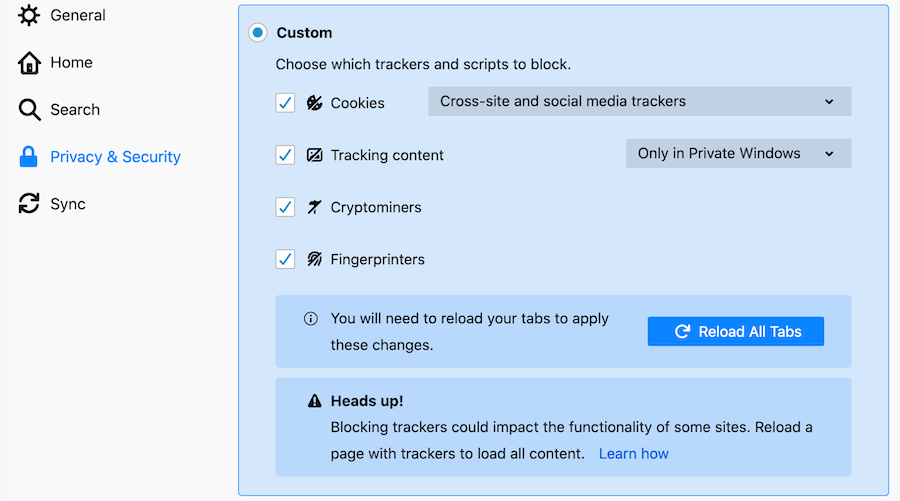
Another great benefit with Firefox is the ability to use numerous browser extensions that will enhance your privacy and security. We’ll go over some of these extensions further below.
Firefox highlights:
- Open source code that has been audited by a third party
- Active development with frequent updates
- Excellent privacy features and customization options
- Many browser extensions supported
- Telemetry and tracking needs to be manually disabled
- Other modifications necessary for more privacy and security
If you want to keep using older add-ons that are no longer supported by the latest Firefox release, you can go with the Firefox Extended Support Release (ESR). If you want a privacy-focused version of Firefox for Android, you could try Firefox focus.
For additional customization and privacy settings, check out our Firefox privacy guide.
Additional security features
IceCat includes additional security features, such as the option to block third party zero-length image files resulting in third-party cookies, also known as web bugs (This feature is available in Firefox 1.0, 1.5, and 3.0, but the UI option was absent on 2.0). GNU IceCat also provides warnings for URL redirection.
In version 3.0.2-g1, the certificate of CAcert.org, a certificate authority, has been added to the list of trusted root certificates. Concern about that decision has been raised in a discussion on the savannah-hackers-public mailing list.
The GNU LibreJS extension detects and blocks non-free non-trivial JavaScript.
IceCat also has functionality to set a different each for different domains in . For example, setting a mobile user agent string for a desired DNS domain would make it possible to view the mobile version of a website on a desktop operating system.
Distribution[]
GNU IceCat is available as a free download for the IA-32, x86_64, and PowerPC architectures. Both binaries and source are available, though the current build is available only for GNU/Linux. Some distributions offer binary and source packages through their repositories, such as Trisquel,Parabola GNU/Linux-libre and Fedora.
IceCat is also available for macOS 10.4 and higher. Any Mac user with these versions of macOS can install IceCat through Fink.
For the Mac, it is available for both IA-32 & PowerPC architectures.
Unofficial builds are available for Windows (Vista or newer) and Android (2.3 or newer).
Distribution[edit]
GNU IceCat is available as a free download for the IA-32, x86_64, and PowerPC architectures. Both binaries and source are available, though the current build is available only for GNU/Linux. Some distributions offer binary and source packages through their repositories, such as Trisquel,Parabola GNU/Linux-libre and Fedora.
IceCat is also available for macOS 10.4 and higher. Any Mac user with these versions of macOS can install IceCat through Fink. For the Mac, it is available for both IA-32 & PowerPC architectures.
Unofficial builds are available for Windows (Vista or newer) and Android (2.3 or newer).
Additional security features[edit]
IceCat includes additional security features, such as the option to block third party zero-length image files resulting in third-party cookies, also known as web bugs (This feature is available in Firefox 1.0, 1.5, and 3.0, but the UI option was absent on 2.0). GNU IceCat also provides warnings for URL redirection.
In version 3.0.2-g1, the certificate of CAcert.org, a certificate authority, has been added to the list of trusted root certificates. Concern about that decision has been raised in a discussion on the savannah-hackers-public mailing list.
The GNU LibreJS extension detects and blocks non-free non-trivial JavaScript.
IceCat also has functionality to set a different each for different domains in . For example, setting a mobile user agent string for a desired DNS domain would make it possible to view the mobile version of a website on a desktop operating system.